Miniature Chihuahua
Miniature Chihuahua Temperament: Helping a Shy Puppy
By Yulia Sky · October 31, 2026
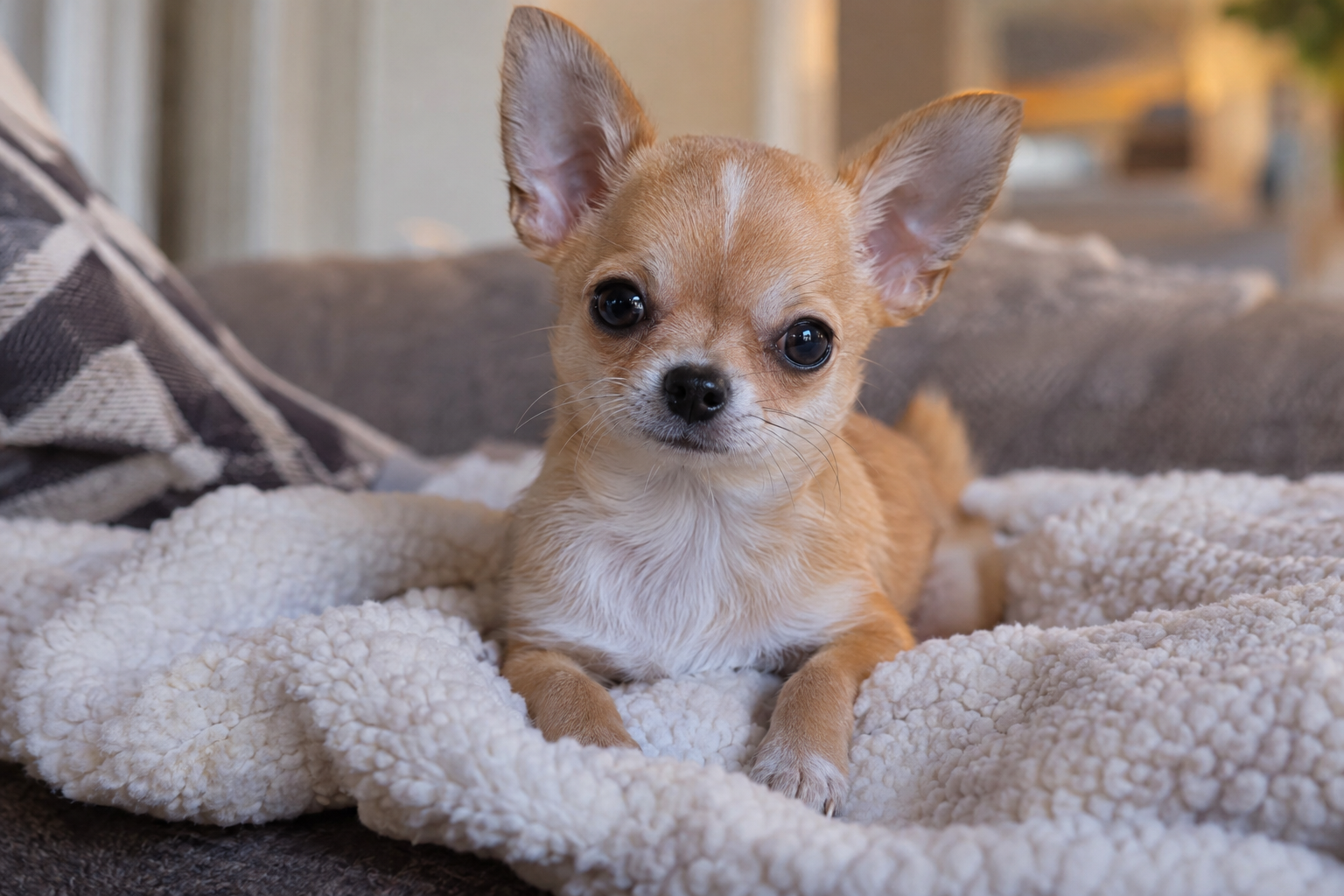
A shy Chihuahua puppy does not need to become the center of attention to develop a comfortable, confident life. The most useful starting point is to distinguish a naturally reserved personality from a puppy who feels overwhelmed, then offer predictable routines and choices rather than forced interaction.
Miniature Chihuahua temperament is not a separate temperament category. Miniature, mini, micro, tiny, and teacup are informal marketing and search terms, not official AKC varieties. The AKC Chihuahua breed standard recognizes one Chihuahua breed, with an adult weight not exceeding 6 pounds, in smooth and long coats. A label does not guarantee adult size, behavior, or health.
I’m Yulia Sky, founder of World Class Puppies, established in 2019. My approach to explaining Chihuahua personality is to focus on the individual puppy’s behavior, not promises attached to appearance or size. Whether you are exploring available Chihuahua puppies or settling in with a new companion, this guide will help you recognize what a cautious puppy needs.
Is my Chihuahua puppy shy or just settling in?
A puppy who is settling in may hesitate around unfamiliar sounds or people while becoming more comfortable with familiar routines. A shy puppy may remain cautious across several situations, but one meeting cannot establish a permanent personality. Look at patterns, including whether the puppy can relax, explore, and recover when pressure is reduced.
The question is not simply, “Did the puppy approach me?” A more useful question is, “What happened before and after the hesitation?” A puppy who watches from a bed, then walks over voluntarily, is showing something different from a puppy who remains motionless while someone repeatedly reaches toward them.
I encourage owners to describe behavior plainly instead of attaching labels such as difficult, spoiled, or antisocial. Useful observations include:
- The puppy approaches when the person sits down.
- The puppy retreats when hands move overhead.
- The puppy explores after a household sound stops.
- The puppy rests comfortably near familiar people.
- The puppy stays hidden even after the room becomes quiet.
These descriptions help you adjust the environment. They also give your veterinarian useful information if a behavior change raises concern.
What does a comfortable Chihuahua puppy look like?
A comfortable Chihuahua puppy generally has a loose body and can shift naturally between watching, exploring, resting, and interacting. Voluntary approach and the ability to disengage are more informative than accepting a cuddle without moving. Read the whole body in context rather than treating a wagging tail as proof of comfort.
Stillness is particularly easy to misread in a very small puppy. Being quiet in someone’s arms does not necessarily mean the puppy enjoys being held. Look for stiffness, turning the head away, repeated attempts to leave, or a sudden reduction in normal movement.
A lowered posture, tucked tail, lip licking, or yawning can occur during discomfort, although each signal can have other explanations. Several signals together, especially during an interaction, are a reason to pause and offer space.
For miniature Chihuahua care, the practical lesson is straightforward: make escape from ordinary social pressure possible. A puppy should not need to escalate from subtle avoidance to growling before a person listens.
How can I help a shy Chihuahua puppy build confidence?
Build confidence by keeping experiences manageable and allowing the puppy to approach or retreat. Introduce one small change at a time, reward voluntary engagement, and finish while the puppy is still comfortable. Repeatedly overwhelming a puppy is not the same as helping them become accustomed to everyday life.
Start with a predictable home base
Choose a secure resting area with comfortable bedding, water access, and nonslip footing. Keep it away from constant foot traffic, and make it a place where people do not reach in to retrieve the puppy for social visits.
The goal is not isolation. Your Chihuahua can observe normal household activity from a distance that feels manageable. Protecting rest is part of Chihuahua puppy care, not a reward the puppy must earn by being outgoing.
Make your posture less demanding
Sit sideways at a comfortable distance rather than leaning over the puppy. Keep hands still initially. If the puppy approaches, resist immediately turning that approach into touching or lifting.
You can quietly place a suitable food reward nearby when it fits the puppy’s normal feeding plan. Avoid using food to lure the puppy closer than they are comfortable being and then reaching for them. Voluntary investigation should remain safe.
Change only one part of the situation
If a puppy is comfortable with you seated, try a small shift in position before standing and walking toward them. If a quiet household sound is manageable, do not combine the next exposure with unfamiliar handling and a busy room.
Think in terms of an easier version and a harder version of each experience. When your puppy struggles, return to the easier version instead of repeating the difficult one until they stop responding.
Let recovery guide the next step
Recovery means returning to ordinary behavior after a surprise or challenge. A puppy might briefly pause, look around, and resume exploring. Another may remain tense or avoid the area afterward.
There is no universal confidence-building calendar. Your puppy’s response should determine whether to repeat, simplify, or stop an activity.
Should I pick up my Chihuahua when they seem frightened?
Pick up your Chihuahua when necessary for immediate physical safety, but do not make lifting the automatic response to every uncertain moment. When the setting is safe, increasing distance or allowing retreat may give the puppy more control. Handling should be gentle and predictable, never a way to prevent the puppy from expressing discomfort.
Small size makes it tempting to carry a puppy through every unfamiliar experience. However, being elevated and restrained may not help a puppy who is already worried about hands or movement. Consider whether you can remove the pressure instead.
For routine handling, begin when your puppy is relaxed. Introduce brief, comfortable contact and pause to observe the response. When lifting is necessary, support the body securely and prevent jumping or falling from arms. Children should not be responsible for carrying a cautious puppy around the home.
If transport is the challenge, a secure carrier may provide a clearer, safer arrangement than holding the puppy loosely. My guide to safe car travel with a Chihuahua puppy explains how to separate travel safety from social expectations.
Are miniature Chihuahuas naturally more nervous?
The miniature label does not establish that a Chihuahua will be nervous, affectionate, bold, or easy to handle. Individual temperament, prior experiences, present surroundings, and physical comfort all matter. Evaluate the puppy in more than one situation rather than treating size as a personality test.
The same caution applies when comparing listings for teacup Chihuahua puppies and Apple Head Chihuahua puppies. Neither a marketing size term nor a head-shape description tells you whether a puppy will enjoy a busy household. Long Hair Chihuahuas also vary individually; coat length is not a reliable shortcut to temperament.
Size expectations can distract buyers from more meaningful questions. My article on why some Teacup Chihuahuas grow larger than expected explains why a size label should not become a promise. For personality, ask about observable behavior instead.
Match a cautious puppy to the household, not an ideal
When considering a miniature Chihuahua for families, I would look first at how the household manages boundaries. A reserved puppy may do well with people who can move calmly, supervise interactions, and accept that affection is voluntary.
Before deciding, ask everyone at home to agree on a few rules:
- Nobody follows the puppy into their resting area.
- Children sit down for supervised interaction rather than chasing or carrying.
- Nobody wakes the puppy for entertainment.
- Retreating ends the interaction instead of starting a pursuit.
- Adults remain responsible for safety and everyday care.
A quieter home is not automatically a better home if the puppy is constantly handled. Likewise, a household with regular activity may be manageable when the puppy has protected space and thoughtful supervision.
Consider your actual availability, too. Confidence-building requires attention to small signals, not continuous entertainment. The discussion in Chihuahuas for working professionals can help you think about routines without assuming that companionship means uninterrupted physical contact.
Ask for descriptions rather than personality promises
Good Chihuahua breeder questions invite specific observations. Instead of asking only whether a puppy is sweet, ask how the puppy behaves when something changes.
Useful questions include:
- What does this puppy do when someone unfamiliar enters?
- Which everyday activities seem comfortable?
- How does the puppy respond to gentle handling?
- What happens after a brief, unexpected household sound?
- Does the puppy choose contact, and how do they ask for space?
- What still feels unfamiliar to this puppy?
No answer can guarantee adult temperament. A responsible discussion should leave room for development, environmental differences, and uncertainty. If you encounter pressure or absolute claims during breeder vetting, use the Chihuahua puppy scam checklist to organize your checks.
For published reference material, you can see our past clients and their puppies. Those experiences are not a prediction of how any particular puppy will behave in your home.
Budget also should not be treated as a temperament score. Each available puppy is individually priced; consult the Chihuahua puppy price guide for purchasing context rather than assuming a higher price means a calmer personality.
Know when behavior needs a health conversation
Any miniature Chihuahua health guide should acknowledge that behavior and physical comfort overlap. Sudden withdrawal, sensitivity to touch, unusual irritability, or a marked change in activity should not automatically be attributed to shyness. Contact your veterinarian about changes, especially when eating, movement, or normal responsiveness also changes.
Weakness, collapse, difficulty breathing, or other severe signs require urgent veterinary attention rather than confidence exercises. This article cannot determine whether a puppy’s behavior has a medical cause.
For persistent fear, ask your veterinarian about appropriate behavioral support. Do not punish growling, force restraint to prove control, or repeatedly expose the puppy to a frightening situation until they become quiet. Quietness alone does not demonstrate improved welfare.
Common questions about living with a reserved puppy
What should I explain to people visiting our home?
Explain that the puppy may watch without greeting anyone. Ask visitors to remain out of the resting area and avoid reaching toward the puppy unless you have established that contact is comfortable. A calm visit with no direct interaction can still be useful.
How much progress should I expect each day?
Expect variation rather than a straight line. Tiredness, household activity, and unfamiliar surroundings can change how confident a puppy appears. Brief notes about context and recovery are more helpful than counting greetings or cuddles.
Choose comfort before sociability
My goal for a shy Chihuahua is not a puppy who tolerates everything. It is a puppy whose people notice discomfort early, create manageable experiences, and appreciate an individual personality. Reserved can be a perfectly acceptable temperament; persistent distress deserves help.
If you are considering your next companion, explore our available Chihuahua puppies and contact us to discuss your household and expectations. For readers using our local hub, Los Angeles Chihuahua puppies provides a separate browsing starting point. Availability changes weekly, and matching should remain a thoughtful conversation rather than a promise based on size or appearance.
Educational disclaimer: This article is for general educational purposes only and is not veterinary advice, diagnosis, or treatment. Consult your own veterinarian about your Chihuahua’s individual health, behavior, nutrition, and care needs. Seek urgent veterinary attention for severe or sudden concerning symptoms.
Frequently asked questions
What should I tell guests before they meet my shy Chihuahua?
Ask guests to leave the puppy’s retreat area alone and avoid reaching, staring, or picking the puppy up. Let the Chihuahua decide whether to approach, and explain that watching quietly is a successful introduction too.
Is a quiet Chihuahua automatically a better match for children?
No. Quiet behavior may reflect comfort, uncertainty, tiredness, or discomfort rather than a patient temperament. A suitable match depends on the individual puppy, adult supervision, and whether children can respect the Chihuahua’s space.
Can I practice confidence-building without using food?
Yes. Comfortable distance, permission to retreat, and access to a familiar resting place can make an interaction easier. If your puppy is not interested in food, avoid assuming stubbornness; consider the setting and discuss unusual appetite changes with your veterinarian.
Should I keep a daily record of my Chihuahua’s progress?
A brief record can help you notice patterns that are easy to miss. Note the situation, the puppy’s response, and what helped, without expecting improvement every day.
Ready to meet your new puppy?
See currently available teacup puppies or reach out to join our waitlist.