Miniature Chihuahua
Why Some Teacup Chihuahuas Grow Larger Than Expected
By Yulia Sky · October 18, 2026
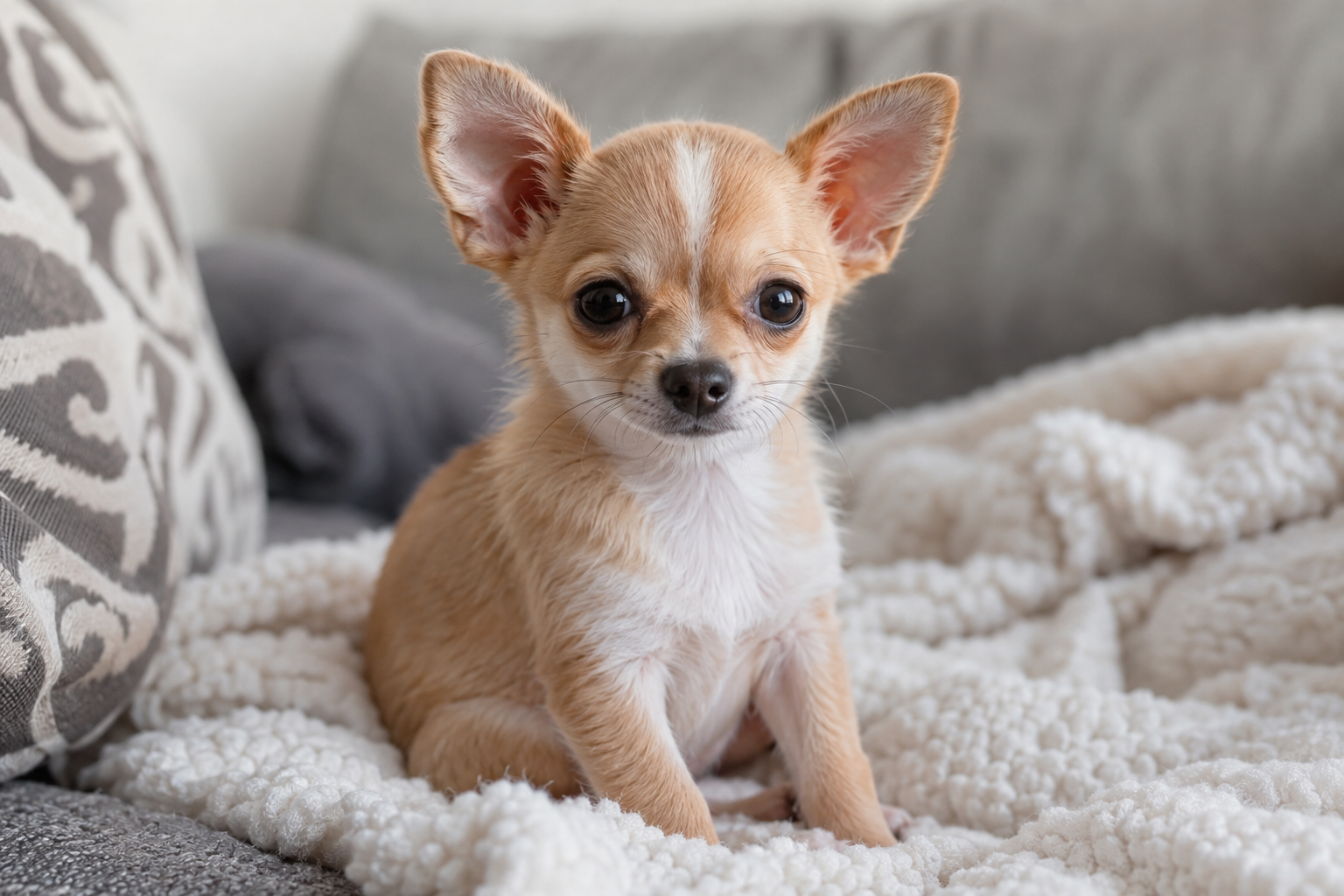
Why Some Teacup Chihuahuas Grow Larger Than Expected
Some Teacup Chihuahuas grow larger than expected because their adult size was estimated before enough growth information was available. Inherited traits, uncertain ages, incomplete records, and overly confident sales language can all contribute. A tiny puppy is a snapshot of development—not a promise of a particular adult weight.
First, an important definition: Teacup, miniature, mini, micro, and tiny are informal marketing and search terms, not official AKC varieties. The AKC Chihuahua breed standard describes one Chihuahua breed, with adult weight not exceeding 6 pounds and smooth or long coats. That standard is not an individual growth forecast or a target owners should achieve by restricting food.
I'm Yulia Sky of World Class Puppies, established in 2019. My approach to this buyer question is straightforward: choose the Chihuahua you can care for, not just the number you hope will appear on a scale. When browsing available Chihuahua puppies, consider the whole puppy and the information supporting any estimate.
Why did my Teacup Chihuahua grow bigger than expected?
A Teacup Chihuahua can outgrow an early prediction because the label does not define a fixed adult size and a young puppy's growth is not perfectly predictable. An estimate may also rely on too few measurements or incomplete family information. Growing beyond that estimate does not, by itself, mean something is wrong.
The first thing I would separate is the prediction from the puppy's actual condition. A Chihuahua can develop a larger frame than anticipated while remaining appropriately lean. Another Chihuahua might have a smaller frame but carry excess body fat. Those situations require different conversations.
Look back at what the original statement actually said. Was it a tentative range, a chart-generated number, or an absolute promise? Was it supported by dated weights? A precise-looking number can sound authoritative even when the underlying information is thin.
Your own veterinarian can assess whether weight gain reflects ordinary development, body condition, or a concern needing further evaluation. A breeder's estimate should never replace that assessment.
Is a Miniature Chihuahua guaranteed to stay small?
No. A Miniature Chihuahua is not a separately standardized size variety, so the name cannot guarantee an adult weight. It describes how a puppy is being presented, not a biological limit on growth.
The same distinction applies when comparing miniature Chihuahua listings with teacup Chihuahua puppies. Neither label establishes a predictable growth ceiling. My guide to Miniature Chihuahua versus Teacup Chihuahua terminology explains why these descriptions often overlap.
Apple Head Chihuahua puppies are not a separate weight category either. Head shape does not establish adult body weight, and a long coat can change how large a Chihuahua looks without revealing the size of the frame underneath.
For buyers, the useful question is not which label sounds smallest. It is whether the puppy's likely range of adult needs fits your home, schedule, and expectations. A companion should still be welcome if the original estimate proves low.
What influences a Chihuahua puppy's adult size?
Inherited traits and individual development influence adult size, while nutrition and health affect how growth unfolds. Parent size provides useful context but does not set an exact limit. Adult weight also includes body fat, so weight alone cannot describe skeletal size or healthy condition.
Family traits are context, not a formula
A puppy inherits traits from both sides of its family. Knowing the parents' mature weights is more informative than seeing an undated photograph, but simply averaging those weights does not produce a dependable answer for every puppy.
European bloodlines, coat color, and appealing head shape do not make growth predictions certain. They should not be presented as proof that a Chihuahua will remain below a particular weight.
Age and measurement quality matter
A weight means more when paired with an accurate birth date and the date of measurement. An estimate based on an incorrect age starts from the wrong foundation. Measurements taken on different scales or entered in mixed units can also make a growth record misleading.
Development does not follow an identical curve
Chihuahua puppies do not all gain weight at the same pace. A slower interval does not necessarily mean growth has ended, and a faster interval cannot be interpreted in isolation. The pattern over time is more useful than one unusually small measurement.
Body condition changes the interpretation
A higher number on the scale may reflect a larger frame, additional muscle, excess body fat, or something requiring medical attention. Ask your veterinarian to interpret weight alongside body condition and a physical examination rather than using an advertised size as the benchmark.
How accurate are Chihuahua puppy weight charts?
Chihuahua puppy weight charts are estimation tools, not guarantees. Their usefulness depends on accurate age, reliable measurements, and how closely the individual puppy follows the assumed growth pattern. A chart should support a conversation about uncertainty, not end it.
I prefer a transparent explanation to a calculator result offered without context. If someone provides an adult-size estimate, ask what information went into it and what could change the conclusion.
A simple record can make that discussion clearer:
| Information | Why it helps | What it cannot establish |
|---|---|---|
| Birth date and measurement dates | Put each weight in developmental context | An exact final weight |
| Several weights using consistent units | Show a trend rather than a single snapshot | That future growth will follow the same pace |
| Parents' mature weights | Add family context | A fixed upper limit for the puppy |
| Current veterinary records | Help your veterinarian understand health history | A lifetime health or size promise |
| Written estimate and its limitations | Clarify what was represented | Biological certainty |
Avoid repeatedly applying different online calculators until one produces your preferred number. That can create confidence without improving the underlying evidence.
What should buyers ask about a Chihuahua size estimate?
Ask how the estimate was made, which dated measurements support it, and how uncertainty is explained in writing. Also ask whether the puppy would still suit your household if it matures larger than predicted. Responsible Chihuahua breeder questions focus on evidence and suitability, not pressure for an exact promise.
Useful questions include:
- What are the puppy's recorded weights and measurement dates?
- Is the birth date documented consistently?
- Are the parents' listed weights mature weights?
- Is the adult-size statement an estimate rather than a guarantee?
- What feeding routine and food is the puppy currently accustomed to?
- What health information will I receive for my veterinarian?
- Where can I review the written terms before making a commitment?
For breeder vetting, use the Chihuahua puppy scam checklist. An exact-weight promise without supporting information deserves careful scrutiny, especially when paired with pressure to decide immediately. The related guide to evaluating a Teacup Chihuahua breeder offers additional context.
When reviewing our terms, read the health guarantee itself rather than assuming it guarantees adult size. Health coverage and growth predictions are different subjects. For references, see our past clients and their puppies, while remembering that another Chihuahua's appearance is not a forecast for yours.
Never try to keep a Chihuahua small by limiting growth
Feeding less to preserve a teacup appearance is not appropriate Chihuahua puppy care. A puppy needs nutrition suited to its development; an advertised weight is not a feeding goal. Do not reduce meals, change portions sharply, or add supplements simply because a chart predicts a larger adult Chihuahua.
Miniature Chihuahua care should begin with the puppy's documented current routine and a discussion with your own veterinarian. Bring the food name, feeding information, and growth record to that conversation. The appropriate plan depends on the individual puppy, not the marketing label.
Very small Chihuahua puppies can be vulnerable when they do not eat adequately. My educational article on hypoglycemia warning signs in Teacup Chihuahuas explains why missed intake deserves attention. Weakness, trembling, collapse, or unusual difficulty waking warrant urgent veterinary attention—not an attempt to adjust growth at home.
Likewise, unexpected weight loss, persistent digestive problems, or a marked change in appetite should be discussed with a veterinarian. This article cannot determine whether a particular puppy's growth is healthy.
Plan for the Chihuahua, not just the predicted number
Before choosing a miniature Chihuahua for families, consider how daily life would work if the puppy becomes a somewhat larger companion. The practical needs remain important: secure handling, supervised interactions with children, safe resting spaces, and equipment that fits the Chihuahua currently wearing it.
Miniature Chihuahua temperament cannot be read from a scale. Ask about the individual puppy's comfort with handling, recovery after unfamiliar experiences, and daily routine. A very small body does not automatically mean a quieter personality or an easier household fit.
Leave flexibility in your setup. Adjustable equipment can be useful, but every item still needs a fit check. Avoid choosing a carrier solely because it fits a young puppy today; check its dimensions and manufacturer guidance against your Chihuahua's changing needs.
If miniature Chihuahua puppy cost is part of your decision, each available puppy is individually priced. Consult the Chihuahua puppy price guide for pricing context and the live listings for individual details. A higher price does not make an adult-size prediction more certain, and the smallest estimate should not outweigh care compatibility.
Frequently asked questions
Should I replace a harness as my Chihuahua grows?
Check the fit regularly and follow the manufacturer's fitting instructions rather than relying on an age label. Replace or adjust it when it restricts movement, rubs, or no longer stays securely positioned. A growing Chihuahua may need different equipment than the items purchased before homecoming.
Can two Chihuahua siblings finish at different adult sizes?
Yes. Siblings can inherit different combinations of traits and follow different growth patterns. Seeing a smaller sibling does not establish the adult size of the puppy you are considering.
Does an adult Chihuahua above the breed-standard weight stop being a Chihuahua?
No. Exceeding a breed-standard weight does not by itself establish that a Chihuahua has different ancestry. Breed standards, ancestry documentation, and an individual Chihuahua's healthy body condition are separate questions.
What if a predicted size influenced my purchase decision?
Keep the listing, dated messages, growth records, and written agreement. Ask the breeder to clarify what was an estimate and what the written agreement actually covers. For a contractual dispute, obtain qualified advice rather than assuming a size prediction creates a particular remedy.
Choose with room for uncertainty
The most useful adult-size estimate is an honest one: supported by records, explained clearly, and presented with limits. My priority is helping you think beyond a label so that normal growth does not turn a welcome companion into an unexpected disappointment.
Meet our available Chihuahua puppies, with availability changing weekly, and contact us to discuss individual information and household fit. If relevant to your search, our Los Angeles Chihuahua puppies page provides a separate local starting point.
Educational disclaimer: This article is for general educational purposes only and is not veterinary advice, diagnosis, or treatment. Consult your own veterinarian about your Chihuahua's growth, nutrition, body condition, and individual health needs. Seek urgent veterinary care for concerning symptoms.
Frequently asked questions
Should I replace a harness as my Chihuahua grows?
Check the fit regularly and follow the manufacturer's fitting instructions rather than relying on an age label. Replace or adjust it when it restricts movement, rubs, or no longer stays securely positioned. A growing Chihuahua may need different equipment than the items purchased before homecoming.
Can two Chihuahua siblings finish at different adult sizes?
Yes. Siblings can inherit different combinations of traits and follow different growth patterns. Seeing a smaller sibling does not establish the adult size of the puppy you are considering.
Does an adult Chihuahua above the breed-standard weight stop being a Chihuahua?
No. Exceeding a breed-standard weight does not by itself establish that a Chihuahua has different ancestry. Breed standards, ancestry documentation, and an individual Chihuahua's healthy body condition are separate questions.
What if a predicted size influenced my purchase decision?
Keep the listing, dated messages, growth records, and written agreement. Ask the breeder to clarify what was an estimate and what the written agreement actually covers. For a contractual dispute, obtain qualified advice rather than assuming a size prediction creates a particular remedy.
Ready to meet your new puppy?
See currently available teacup puppies or reach out to join our waitlist.